
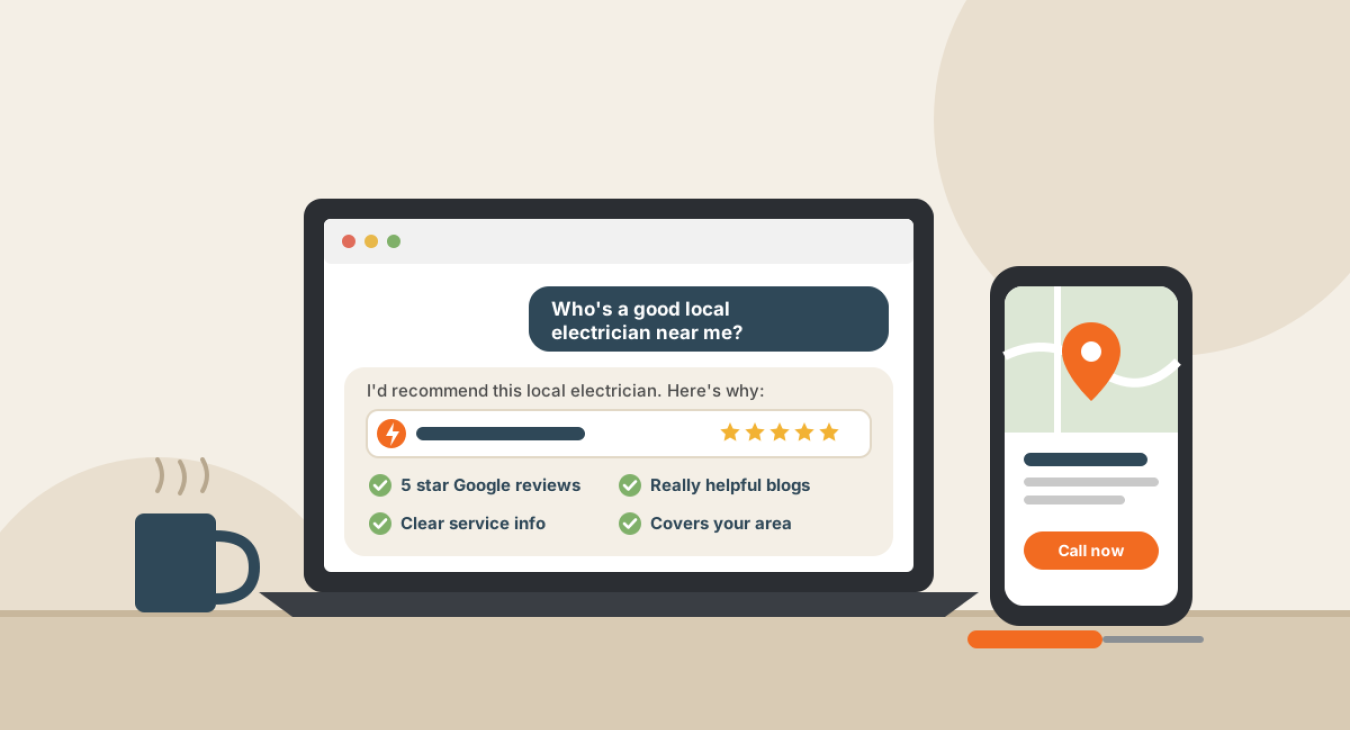
More and more people aren't typing searches into Google anymore. They're asking AI. They type a full question into ChatGPT, Claude, Copilot or Gemini, something like "who's a good electrician in Gillingham?", and get a straight answer back, often with a business name or two in it.
So the question I'm being asked more and more by tradespeople is this: how do I get my business to be one of those names?
And alongside that question comes a whole new wave of people offering to take your money to fix it.
The new buzzword: AEO
If you haven't heard it yet, you will. AEO stands for Answer Engine Optimisation. The idea is that AI tools are "answer engines" because they give people an answer rather than a list of links, and you need to optimise your business for them.
That part is true. People are asking questions, and AI tools are answering them.
What I don't agree with is the idea that this is some brand new, separate thing you need to pay extra for on top of your website and SEO. In my opinion it isn't.
AI looks for the same kind of things Google does
I've been building websites and doing SEO for tradespeople for nearly 20 years, and I was an electrician before that. Here's what I can tell you plainly.
AI doesn't just copy Google's results. When ChatGPT searches the web for something like a local electrician, it can run its own searches, pull in business listings from other providers and then weigh up what it finds. Nobody outside OpenAI knows exactly how it decides, but the evidence that shows you're the right person for the job is the same kind Google has always cared about:
- What you actually do, and whether you're right for the job being asked about
- Whether you cover the area the customer is in
- Your reputation, meaning what your reviews actually say about your reliability and workmanship
- Proof that you're qualified, like registrations that can be checked
- Examples of your work and other sites backing up what you say about yourself
Sound familiar? It should, because it's exactly what good SEO has always been about.
If your website is built properly, with proper page titles and descriptions, dedicated pages for each of your services and the areas you cover, and genuinely helpful content, then you've given AI what it needs to understand your business and work out whether you're right for the customer.
Good websites also include structured data, which is code in the background called schema markup that spells out who you are, what you do and where. It's good practice and it makes your details crystal clear, but to be straight with you, OpenAI hasn't said it plays any part in who ChatGPT recommends. Anyone telling you it's the secret to AI is guessing.
A properly built website already does most of the job. There's no separate trick.
So why are people selling it?
Because it's new, it sounds clever and most tradespeople don't have the time to dig into what it actually means. That's not a criticism of tradespeople, it's just a fact. You're busy running jobs, not reading about search algorithms.
So when someone says "your business isn't optimised for AI", it sounds worrying. It's an easy sale.
Here's something worth knowing. Nobody outside these AI companies knows exactly how they rank businesses, because they don't publish it. So anyone promising to get you to the top of ChatGPT is guessing.
If someone is offering you AEO as an extra, ask them one question: what exactly will you change on my website that wouldn't be part of doing SEO properly in the first place? If the honest answer is "not much", you've got your answer.
The few things that genuinely do matter
Now, I'm not going to tell you there's nothing to it. There are a handful of things that matter for AI which a lot of websites, even decent ones, miss. None of them are expensive or complicated, but they're worth knowing about.
1. It's not just about Google
Most tradespeople know about their Google Business Profile, and quite right, it's hugely important. But the AI tools don't all get their information from Google. ChatGPT uses its own search and other providers, and Microsoft's Copilot uses Bing.
So don't put all your eggs in one basket. Claim your listing on Bing Places and Apple Business Connect as well as Google, and make sure your business name, address, phone number and opening hours are exactly the same on every one of them. They're all free, and the more places your details are correct, the better.
2. Make sure the AI can actually read your website
This one surprises people, and there are two ways it commonly goes wrong.
The first is blocking. Some website hosts and security services now block AI tools from reading websites, sometimes by default, without the business owner ever knowing. ChatGPT's search uses something called OAI-SearchBot to read websites. If that's blocked, your website can't be used as a source in ChatGPT's search answers. It's worth asking whoever looks after your website to check it isn't being blocked.
The second is how the site is built, and I'm seeing this more and more. A lot of the newer quick build and AI website builders create sites where the whole page is put together by JavaScript in your browser. It looks perfectly fine to you and your customers. But behind the scenes, the actual code of the page is almost empty. No text about your services, no areas covered, no reviews. Just an instruction telling the browser to go and build it all.
Google can usually work its way around that, although it doesn't always. But many AI tools don't run JavaScript at all. They read the raw code of the page, and if that's empty, they see nothing. Your website could look great and still be invisible to them. Not every JavaScript site has this problem, as some are set up to send the full page anyway, but plenty don't.
You can do a quick check yourself in a few seconds. Open your website on a computer, right click anywhere on the page and choose "View page source". If you can see your actual wording in there, like your services and the towns you cover, that's a good sign. If it's mostly code with hardly any of your words in it, that's a red flag, and it's worth getting whoever built your site to look into it.
Every website we build serves the full page straight away, so Google, AI and everyone else can read every word of it from the start.
3. Answer the questions your customers actually ask
AI tools love clear, straight answers. If someone asks "how much does it cost to replace a fuse board?" and your website has a page or a blog that answers that question properly, with real experience behind it, you've given the AI something useful to work with.
This is exactly why we've always pushed our customers to have helpful blogs and FAQs on their sites. Not filler written to tick a box, but real answers to real questions, written by people who know the trade. That's what both Google and AI are looking for.
4. Make your registrations easy to check
Anyone can stick a NICEIC, NAPIT or Gas Safe logo on their website. A logo on its own proves nothing. The registers are public, though, and AI can check them.
So put your registration details on your website clearly, and make sure your business name matches what's on the register. The easier it is for anyone, person or AI, to confirm you are who you say you are, the better.
5. Your reputation everywhere, not just on your website
AI builds up a picture of your business from whatever it can find across the web. Your Google reviews, your Facebook page, your Checkatrade or Which? profile if you have one, local directories, local news, the lot.
And it's not just about how many stars you've got. When AI reads your reviews, it can take in what customers actually say. If customer after customer says you turned up when you said you would, kept the place tidy and did a great job, that says far more than a number does. So keep asking happy customers for reviews, and ask them to say what you did for them.
What this means for you
If you're one of our customers, the honest answer is that most of this is already being done for you. Your site is built so every word can be read straight away, with clear service and area pages, helpful content and your details set out properly. If you want us to check things like your Bing and Apple listings or your registration details, just give us a shout and we'll go through it with you.
If you're not one of our customers and someone is trying to sell you AEO as a separate service, my advice is simple. Make sure your website is built properly, your listings are filled in properly, your details are consistent and your reviews keep coming in. Nobody can promise you a spot in ChatGPT's answers, but getting the basics right gives you the best chance of being found, on AI and on Google.
There's no shortcut and there's no magic. There's just doing it properly.
Want help getting your business found, whether that's on Google or ChatGPT? Get in touch and let's have a chat.