Tradespeople built their businesses on relationships. AI is being sold as a way to scale that, but what's actually happening is the very thing that made trades different from corporates is being stripped out. Here's what's going on, and how to stay on the right side of it.
By Gary Pratten · Founder, My Local Trades · 32 years in the electrical industry
A quick word before we start
I'm not anti-AI. I want that clear from the off, because what follows is going to read pretty firm in places, and I don't want anyone misunderstanding where I'm coming from.
We use AI every single day in our office. It helps Lisa, Lillie, Ranjali and me do our jobs faster, better, and to a higher standard than we could without it. AI is one of the most useful tools to land in our industry in twenty years.
But there's a massive difference between AI as an aid and AI as a replacement. And what I'm seeing right now in the UK trades industry, what's being sold to honest electricians, plumbers, builders and roofers by tools and agencies that should know better, is the second one. It's costing tradespeople their Google rankings, their customer relationships, their reputations, and in some cases their data security.
This article is my honest read on what's happening. I've broken it down into the seven biggest areas where I'm seeing AI being misused in our industry, followed by a proper section on where AI genuinely shines, with real examples of how my team and I use it every day to do better work in less time.
The bigger picture: what makes trades different in the first place
Before we get into the seven areas, here's the thing nobody pitching you AI tools wants to talk about.
Tradespeople are not Tesco. You did not build your business on volume, automation, or scale. You built it on relationships. Word of mouth. The fact that Mrs. Jenkins from down the road tells everyone at the school gate that you turned up when you said you would and didn't leave a mess. The fact that you remembered the dog's name when you went back two years later for a fault. The fact that you replied to a 3-star review by name, by hand, and made it right.
That personal touch is the entire reason customers pick a local tradesperson over a national chain. It is your unfair advantage. And it's exactly what's being quietly hollowed out by lazy AI use.
Once it's gone, you're competing on price like everyone else. And that's a race nobody in the trades wants to win.
1. AI-generated blog content (the SEO trap)
Let's start with the most obvious one, because it's where most tradespeople are first exposed to bad AI advice.
Over the last 18 months, a wave of "AI SEO" tools has aggressively targeted UK tradespeople with the same pitch: "Rank Number 1 on Google on autopilot. 30+ blog posts a month while you sleep. Save thousands on copywriters." Some marketing agencies that target trades have also quietly switched to AI-only content while continuing to charge premium copywriting rates.
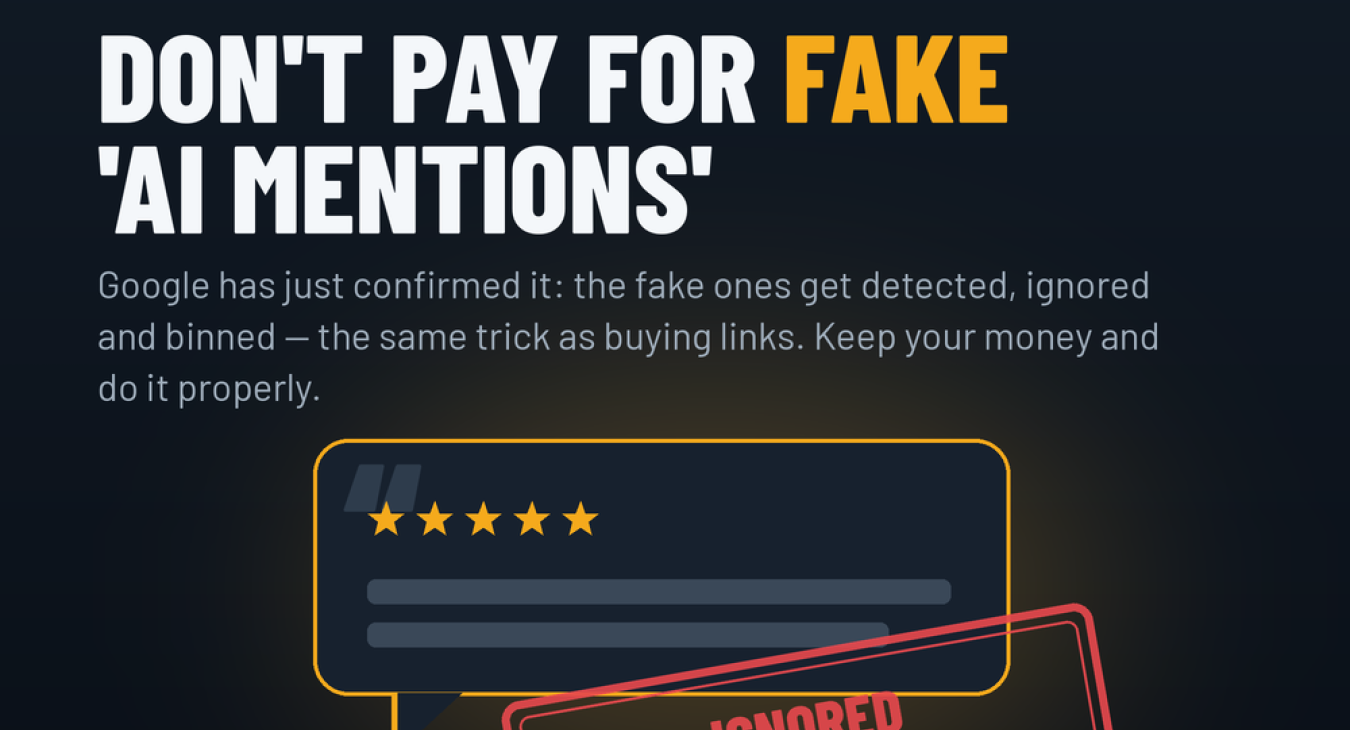
Here's the problem. Google has a published name for this approach: scaled content abuse. Their spam policies clearly state that using automation, including AI, to generate large volumes of pages primarily to manipulate rankings is a violation of their guidelines. Sites doing it are not climbing Google, they are being deindexed, penalised, or quietly demoted.
For trades, the risk is amplified. Google classifies electrical, plumbing, gas and most construction-related content as YMYL — "Your Money or Your Life" — because the work directly affects a reader's safety. The quality bar for YMYL content is deliberately set higher. Pair that with Google's E-E-A-T framework (Experience, Expertise, Authoritativeness, Trust) and you've got an industry where Google specifically wants to see content that could only have been written by someone with actual real-world experience. Generic AI text fails every one of those four pillars.
Quick gut check: Pull up your most recent blog post. Does it mention a specific job? A specific customer? A specific street, town or postcode? Does it sound like you, or someone who actually does your job? If the answer is "no" or "I'm not sure", Google has probably already noticed.
2. AI review responses (the personal touch killer)
This is the one that genuinely bothers me the most. Because the maths just doesn't add up.
The average tradesperson gets somewhere between two and ten Google reviews a month. Some get more, most get fewer. A new "AI review reply" tool has appeared, claiming to save tradespeople hours by generating "personalised" responses to every review automatically. Let's stop and think about that for a minute.
If you're getting five reviews a month, replying to each one personally takes you around fifteen minutes total. That is not a time problem. That is the most valuable fifteen minutes you'll spend on your marketing all month. A customer has just gone out of their way to publicly say something kind about your business. Replying to them by hand, by name, with a sentence that shows you actually remember the job, that's not a chore. That's the entire point.
Customers can spot AI review replies a mile off. They're vaguely warm, generically grateful, and contain phrases like "we're delighted you chose us as your trusted electrical partner" that no human tradesperson has ever said out loud. Worse, when other potential customers read your review profile, they don't just read the reviews — they read your replies. Twenty AI-generated replies in a row tells a story. And it's not the story you want telling.
The same logic applies to negative reviews, by the way, possibly more so. A 1-star review answered by AI looks dismissive. A 1-star review answered by you, by name, taking responsibility and offering to put it right, that turns a complaint into a sales pitch for the next ten people who read it.
If you're too busy to write five review replies a month, you've got a bigger problem than AI can solve.
3. AI-generated email and quote replies (the trust erosion)
This one is creeping in quietly. Tools that auto-generate replies to customer enquiries from your website, or auto-draft quotes from a few keywords. The pitch is the same, "save time, never miss a lead, scale your sales process."
Two problems with this in the trades world.
First, customers contacting a local tradesperson are doing so specifically because they want a human conversation. They've already rejected the option of a national chain or a big-corporate booking system. The moment your reply comes back sounding like a chatbot, even a good one, you've broken the very promise that got them to enquire in the first place.
Second, AI-generated quotes are dangerous. An AI doesn't know your van stock, your supplier's current copper price, your hourly rate this quarter, or that the customer's address is a four-storey Victorian terrace in a parking-restricted street that'll add half a day to the job. AI-generated quotes are either wildly under-priced (and you eat the loss) or wildly over-priced (and you lose the job). Either way, it's not saving you anything.
The good news is the answer here is very simple. Reply to enquiries yourself, or have someone in your office reply by hand. If you genuinely can't keep up, that's a hiring problem, not an AI problem.
4. AI chatbots pretending to be you (the trust violation)
You may have seen the website chat widgets that appear to be the tradesperson themselves — "Hi, I'm Dave! How can I help?" — when they're actually an AI bot, often white-labelled by the agency selling it.
This is a step further than the AI replies issue, because it crosses a clear ethical line. A potential customer is being led to believe they're talking to the business owner, when they're not. They're sharing details about their property, their problem, sometimes their phone number to what they think is a person. They aren't.
Beyond the ethics, there's a legal angle. Under UK consumer protection rules, misleading customers about who they're dealing with is a problem. Under GDPR, collecting personal data via a chatbot without clearly disclosing it's automated and how that data is processed can be a breach. I'm not a lawyer, and I'd recommend you speak to one before installing any chatbot, but at the very least, your chatbot should be clearly labelled as automated, and any personal data it collects should be properly disclosed in your privacy policy.
If you want to capture out-of-hours enquiries, a simple form with a clear "we'll reply within X hours" promise does the same job, without pretending to be something it isn't.
5. AI-generated images (the fake-job-photo problem)
I've started seeing this on tradespeople's websites and Google Business Profiles in the last six months and it makes my heart sink every time.
AI-generated images of "completed jobs" that never happened. Stock-looking AI photos of consumer units, boilers, kitchens, roofs, all generated to fill a gallery. The hands have six fingers if you look closely. The wiring isn't to UK regs. The boiler model doesn't exist. The light switches are American.
Two issues here, and they're both serious.
First, your job gallery is one of the most powerful E-E-A-T signals you have. Real photos of real jobs, with real EXIF data, real geolocation tags, and ideally a sentence or two about what the job involved, these are direct, undeniable evidence to Google (and to customers) that you actually do the work you say you do. Fake AI images are the opposite. They're a signal of inauthenticity that Google's image recognition and customers' eyes are both increasingly good at spotting.
Second, and this is the bigger one, there's a reputational risk. A potential customer who spots a fake photo on your website doesn't think "oh well, the other photos are probably real." They assume the whole site is dodgy. Trust takes years to build and one obviously-AI image to break.
Take photos on your phone. Five seconds at the end of every job. That's all you need.
6. AI-generated Google Business Profile posts (the lazy local SEO play)
GBP is one of the most powerful local marketing tools a tradesperson has, and it's also one of the most abused with AI.
Auto-generated weekly GBP posts saying things like "Need a reliable electrician in [TOWN]? Look no further! Our team of certified professionals is here to help with all your electrical needs..." These are everywhere. They're useless.
Google rewards GBP profiles that show genuine, ongoing business activity. A real photo from this morning's job, with a sentence in your own words about what it involved, beats fifty AI-generated "promotional posts" every single time. The whole point of GBP is to demonstrate that you are an active, real business in a specific local area. AI-generated posts demonstrate the opposite.
Two minutes at the end of a job. Phone photo. One genuine sentence. Posted to GBP. Done. That's the entire workflow, and it beats every AI tool on the market.
7. AI-generated code, forms and widgets (the security trap)
This is the area that worries me most from a safety perspective, and as a sparky I don't say that lightly.
I've seen tradespeople encouraged by various YouTubers and "AI experts" paste AI-generated PHP, JavaScript or HTML code into their websites without understanding what it does. Booking forms, quote calculators, custom contact widgets, "free" plugins generated on the fly. The sales pitch is "anyone can build software now."
Here's the reality. AI-generated code, particularly for forms and widgets that handle customer data, frequently contains:
- SQL injection vulnerabilities where a malicious user can read or destroy your customer database through your contact form.
- Cross-site scripting (XSS) holes allowing attackers to hijack customer sessions or redirect them to malicious sites.
- No GDPR compliance collecting personal data without proper consent flows, privacy policy links, or data retention controls. This is an ICO matter, and the fines for small businesses are not symbolic.
- No CSRF protection meaning forms can be submitted automatically by bots and your inbox flooded with spam, or worse.
- Outdated practices AI training data lags behind current security standards by months or years. Code that "works" can still be insecure.
I want to put this as plainly as I can. As a tradesperson, you would never wire a consumer unit using a YouTube video and a hope. You'd test it, certify it, and put your name on it. The same standard applies to code on your website. If you don't know what it does, don't paste it. If you don't have someone who knows what it does, don't paste it.
The "I'll just ask AI to write me a booking form" approach is exactly how small businesses end up reporting data breaches to the ICO, and exactly how customer trust gets destroyed in a single incident.
Where AI genuinely shines (and how I use it every day)
At this point in the article, some of you are probably thinking I'm one of those "AI bad" doomsayers. I'm absolutely not. I want this section to balance things out properly, because the real story isn't "AI is bad", it's "AI is massively useful when used as an aid, and incredibly damaging when used as a replacement."
Let me give you a concrete example from my own work, because I think it's the clearest way to explain the difference.
A real-world example: building software for my own businesses
Alongside My Local Trades, I run and develop several other software platforms in-house, internal tools for our office, customer-facing systems for our clients, and back-end infrastructure for various projects I'm involved in. A typical project might involve writing 1,000+ lines of PHP, MySQL queries, JavaScript and HTML to build something genuinely useful.
Before AI, writing 1,000 lines of working, tested, secure code took me somewhere between 12 and 20 hours of focused work. Thinking, structuring, writing, debugging, fixing, retesting. Anyone who's coded knows this is the reality, most of the time isn't spent typing, it's spent solving problems.
With AI as an aid, the same 1,000 lines now takes me roughly 3–5 hours. But, and this is the bit that matters, those 3–5 hours include me reviewing every single line, testing it, finding the bits AI got wrong (and there are always bits it got wrong), fixing the security issues, making sure the database queries are efficient, and signing off on the final result. The thinking and reviewing time hasn't shrunk. The typing time has. That's where the genuine saving is.
Here's the honest comparison:
| Task: Build 1,000 lines of working, secure code | Time | Quality / Safety |
|---|---|---|
| Manual coding (pre-AI) — me, writing every line by hand, debugging as I go. | 12–20 hrs | ✅ Solid |
| AI as an aid — I plan the structure, AI drafts code blocks, I review/test/fix every line, then sign off. | 3–5 hrs | ✅ Solid |
| AI as a replacement — paste the prompt, copy the output straight to the website. No review. | ~30 min | ❌ Dangerous |
That middle row is the sweet spot. That's where AI is brilliant. I get the same finished product I'd have built before, to the same standard, in roughly a quarter of the time. The work I save is the boring, repetitive, mechanical part of writing code. The work I keep is the thinking, the architecture, the security review, the testing, and the final sign-off which is the actual valuable bit.
That third row is the trap. The "30 minutes" version looks amazing on paper and absolutely terrible in production. That's the version being sold to tradespeople by tools and YouTubers and it's the version I want to make sure none of you fall for.
The same principle applies to everything else AI can do for you
Code is just one example. The same "AI compresses the typing, the thinking stays human" principle holds true for almost every task in a trade business. Here are some genuine, useful, tradesperson-friendly ways we use AI in our office every day:
- Turning voice notes from a job into proper notes. One of our team or I can dictate "replaced consumer unit at 14 Acacia Road, found older Wylex board with mixed cable colours, RFC1 had a fault on the live conductor, replaced with new Hager unit, ZS readings within tolerance" AI tidies it into clear, professional job notes in seconds. We then read it, fix anything off, and save it. Saves 10–15 minutes per job.
- Drafting customer-facing explanations. A customer asks "why does my RCD keep tripping?" we can dictate the technical answer in tradesperson-speak and AI rewrites it in plain English a homeowner will understand. We always read it back, adjust the tone, and send it ourselves. Genuinely better customer experience, no time lost.
- Brainstorming and structuring blog ideas. If we're stuck for what to write about, AI is a great sounding board. "Here's a real job we did this week, what are the angles a homeowner would search for?" Then a human writes the actual article using the real story, real photos, real expertise.
- Speeding up admin and email drafting. Drafting a reply to a routine supplier query, putting together a meeting agenda, summarising a long email thread, AI handles the boring middle bit, a human reviews and sends. Saves real time without removing the human from the loop.
- Research and learning. "Explain how Section 75 of the Consumer Credit Act applies to a faulty installation" — a brilliant first-pass explanation in seconds, which you then verify against the actual legislation before relying on it. Used to take an hour. Now takes ten minutes.
- Code review and security checks. Yes, even though we write our code with AI as an aid, we also use AI to review code for potential security issues, alongside human review and testing. Belt-and-braces. (Note: AI is good at flagging common problems but it absolutely does not replace human security review and proper testing.)
Notice the pattern? In every single one of these examples, AI is doing the heavy lifting on the boring/repetitive bit, and a human is doing the thinking and signing off. That's the formula. That's where AI is genuinely transformational, and that's exactly how my team and I use it every day.
If you take one thing away from this whole article, let it be this: AI is brilliant at compressing time. It is terrible at replacing judgement. Use it for the first. Never trust it with the second.
So what does good AI use actually look like?
Let me be absolutely clear, because by this point in the article some readers will be thinking I want everyone to ditch AI. I don't. I want everyone to use it properly.
Here's the dividing line, simply put.
✅ AI as an aid (what we do)
- A real human starts every piece of work with real-world input, a real job, a real customer, a real story, a real photo.
- AI helps speed up the work, drafting, structuring, checking grammar, generating ideas, suggesting improvements.
- A human reviews, edits, rewrites where needed, and personally signs off on the final output before it goes anywhere near a customer.
- The customer-facing result is indistinguishable from work done by a skilled human, because in every meaningful sense, it was.
❌ AI as a replacement (what's killing trade businesses)
- A topic, a review, an enquiry, an image, a piece of code is fed into a tool with no real-world input.
- The output is published, sent, or pasted with no human review.
- The customer-facing result is generic, untrustworthy, occasionally insecure, and clearly not from a human.
- The tradesperson saves time in the short term and pays for it in lost rankings, lost trust, lost customers and, in the worst cases, lost data.
The test is simple: would you put your name on it, in front of your best customer, and stand by every word of it?
What we do at My Local Trades
I'll keep this part short because the rest of the article speaks for itself. Here's our position, plainly stated.
Every website we build is designed by a human, for the specific tradesperson who'll use it. Every blog post is written or fully edited by a human on our team, me, Lisa, Lillie or Ranjali. and we use AI only as an aid to work faster. Every line of code on our sites is written by a human who understands web security, GDPR and UK trade-specific requirements. Reviews, customer emails, GBP posts, social posts. All of it is human work, because that's what actually builds a business.
We don't promise hands-off rankings or autopilot anything. What we do promise is that in two years' time, when half the tradespeople who took the AI shortcut are starting from scratch trying to recover deindexed sites, fix data breaches, or rebuild trust with customers, your business will still be going, still be ranking, and still be worth what you've put into it.
That's the difference. And in this industry, it's the only difference that actually matters.
A final thought from one sparky to another
I want to leave you with something that I think makes all of this click for any electrician reading, and honestly, for any tradesperson at all, because the principle is the same in every trade.
Anyone can run in a ring main. Three cables in, three cables out. Line, neutral, earth. Strip the cores, terminate them. The sockets work. Customer's happy. Job done.
But what an unqualified person doesn't know, what only a qualified electrician knows, is whether that ring main is actually safe. Will the MCB trip in time under a fault? Is the Zs reading low enough for proper disconnection? Is the disconnection time within 0.4 seconds for a final circuit? Is the earth continuity unbroken end-to-end? Will it overheat under sustained load? Will the RCD trip in 30 milliseconds if someone gets a shock? Has it been tested with a proper MFT and certified?
That's the gap between "it looks like it works" and "it's actually safe."
That gap is the entire reason our trade exists. It's why we get paid. It's why Part P exists. It's why we have the regs, the testing equipment, the qualifications, the certificates. Because the visible bit, three cables in, three cables out, is the easy part. The expertise is in everything you can't see, and everything that only matters when something goes wrong.
AI is exactly the same.
Anyone can paste a prompt into ChatGPT and get a blog post out. Anyone can ask AI to write a contact form. Anyone can let AI reply to their reviews. The visible bit looks like it works. The lights come on.
But what most tradespeople, and most marketing agencies, frankly don't know is whether what they've just published is actually safe. Will Google penalise the site? Is the form leaking customer data? Are the reviews damaging trust instead of building it? Is the chatbot breaking GDPR? Are the AI photos costing you E-E-A-T? You can't see any of that from the surface. It only shows up when it goes wrong, and by that point, the damage is done.
You wouldn't let an unqualified DIYer wire your customers' houses. You shouldn't let an unqualified DIYer "wire" your business's online presence either. The cost of getting it wrong is the same in both cases, it's just slower to show up online, which is exactly what makes it so dangerous.
If you wouldn't DIY your trade, please don't DIY your AI. Get someone qualified to do it properly, whether that's us, or anyone else who genuinely understands the work. Your business is worth that.
Gary
Worried about your own setup?
If anything in this article has made you uneasy about your current website, content, reviews, or any other part of your online setup, I'm happy to take a look — no charge, no pitch. I'll give you an honest read on what's helping, what's hurting, and what (if anything) needs sorting.