
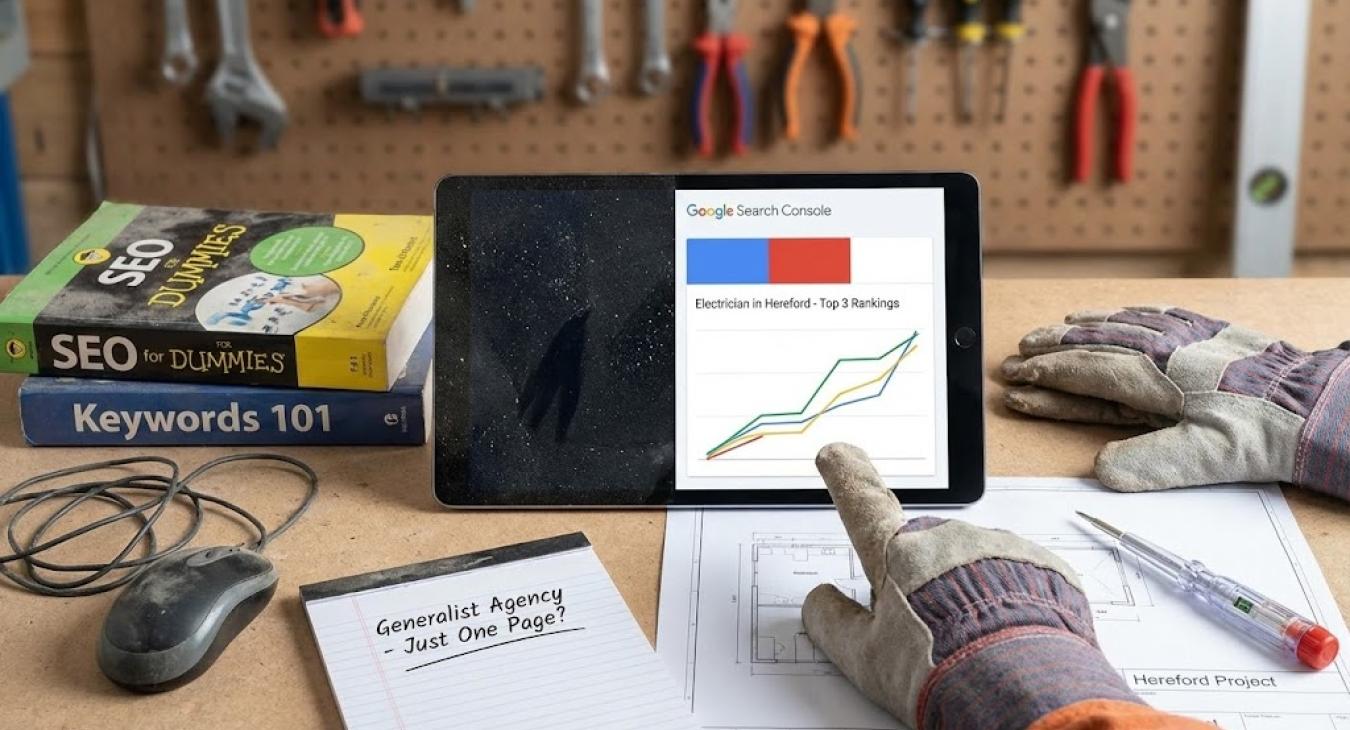
If I had a pound for every time a customer told me some random SEO agency had warned them about “keyword cannibalisation”, I’d be sipping a cold drink somewhere warm by now.
Here’s the usual scenario:
- You run an electrical or plumbing business. You want to rank for “Electrician in [Your Town].”
Some general SEO agency has a quick look at your site and panics:
- “You’ve got a blog post mentioning [Your Town] AND a landing page for [Your Town]. You’re confusing Google! You can only have one page!”
Honestly… no. They are wrong. And I can say that confidently after 18 years of doing this and managing over 200 trades websites.
Old School Thinking vs How Google Actually Works Now
Back in the old days, Google was thick as bricks. If you repeated the word “electrician” too many times, it didn’t know what to do with you.
Today? Completely different. Google understands search intent!
Your main landing page = Transactional intent
Customers are thinking:
- “I’ve got a problem, I need someone now.”
Your blogs = Informational intent
Customers are thinking:
- “I want advice, examples of your work, or to learn something.”
So when a generalist SEO tells you to delete your blogs or stop writing them, they’re treating your business like you’re selling socks on Amazon. They’re basically shutting your shop windows and wondering why fewer people walk in.
How We Actually Rank Tradespeople, The Hub & Spoke Approach
We don’t play the “one page only” game. We use what’s called a topic cluster approach.
Think of your main “Electrician in Hereford” page as the centre of a spider’s web, the strong core. But a web with no supporting threads just collapses. So we build articles around it:
- Recent jobs you’ve done in the area
- Safety tips for local homeowners
- Changes in wiring regulations
- Seasonal electrical advice
And we link them all back to your main service page.
This doesn’t confuse Google, it helps Google. It basically says:
“Not only does this electrician work in Hereford, but he clearly knows his stuff. Look at all this helpful content backing it up.”
That’s how my clients take the top spots.
Think BBC News. Not a Dusty Shop Window.
If the BBC reports on a flood in March, and then another in October, do they delete the March article? Of course not. They publish a new one because it shows activity. Your business is the same.
If your website has one lonely page that hasn’t changed since 2023, Google assumes you’re dead. Regular, local content like project write-ups, safety reminders, new regulations (not too technical!), creates a timeline. It shows you are active, trading, and trusted.
Why Specialists Like Me Get Better Results Than General SEO Agencies
Generalist SEOs work from textbooks. I work from actual data. I’ve spent nearly two decades running trades websites across the UK. I don’t guess, I can literally see what Google rewards in this industry. And the truth is very simple:
- Trades businesses that publish regular, helpful, intent-based content dominate their area.
- Businesses that rely on a static “brochure” website get stuck on Page 2 or worse! and stay there.
So don’t let an SEO agency convince you that being too helpful or too active is a bad thing. If you want to dominate your local area, you need to show Google that you’re the local authority, and you can’t do that with silence. Write, share, show your work, and stay active. Google loves it. Your customers love it. And it works, every single time!